Item | Serial Number | Parameter Items | Unit | ES200 | ES300 |
Rock Drilling | 1 | Impact Energy | J | 120-200 | 250-300 |
2 | Impact Frequency | Hz | 30-50 | 30-50 | |
3 | Impact Working Pressure | MP a | 16-19 | 16-19 | |
4 | Impact Working Flow | L/min | 35-50 | 55-65 | |
5 | Rotation Torque | N·m | 100-300 | 100-300 | |
6 | Rotation Speed | r/min | 220-450 | 220-450 | |
7 | Rotation Working Pressure | MP a | 7-15 | 7-15 | |
8 | Rotation Working Flow | L/min | 40-70 | 40-70 | |
9 | Machine Weight | Kg | 115 | 115 | |
10 | External Dimensions | mm | 587x140x252 | 748x140x252 | |
11 | Edge Distance | mm | 70±0.37 | 70 | |
12 | Drill Hole Diameter | mm | 28-45 (64 large) | 38-89 | |
13 | noise | dBA | ≤120 (5-point average) | ≤120 | |
Overall | 1 | Large Drill Hole Depth | m | 15 meters | 15 meters |
2 | Advance Pressure | MP a | 5-14 | 5-14 | |
3 | Advance Flow | L/min | 10 | 10 | |
4 | Single Large Drill Hole Depth | m | 5.6 | 5.6 | |
5 | Drilling Speed | m/min | 0.5-1.0 | 0.5-1.0 | |
6 | Slag Discharge Volume | M3/min | 1.2-3.2 | 1.2-3.2 | |
7 | Slag Discharge Pressure | bar | 5-8 | 5-8 | |
8 | Lubrication Air Volume | M3/min | 0.02-0.05 | 0.02-0.05 | |
9 | Lubrication Air Pressure | bar | 3-6 | 3-6 | |
10 | Machine weight | kg | 1100-1500 | 1100-1500 |
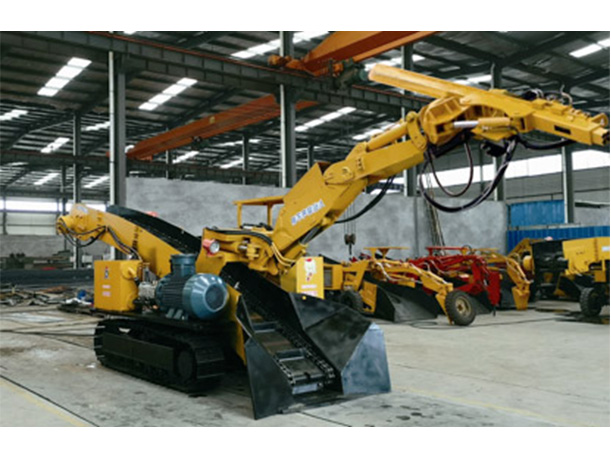
Equipped with a three-section arm (with a breaker hammer), it is suitable for coal mine tunneling, coal mine opening, and rapid slag discharge in semi-coal rock tunnels. The three-section arm loader can compensate for the dead angles that standard two-section arm loaders cannot reach, expanding the working range.
2. Diesel Engine
For non-coal mine tunneling machines, a diesel engine can be optionally used for travel power. The equipment has strong mobility for turning, making it suitable for frequent turning and long-distance tunnels, and can achieve hybrid oil-electric power.
3. Cable Reel
Enables flexible automatic retraction and release of cables during equipment advance and retreat, saving manpower and material resources, with higher automation levels, making loader operations more flexible and effortless.

Please leave us a message